Future of the Waterfront

A cartoon that Malcolm Walker showed as part of his lecture.
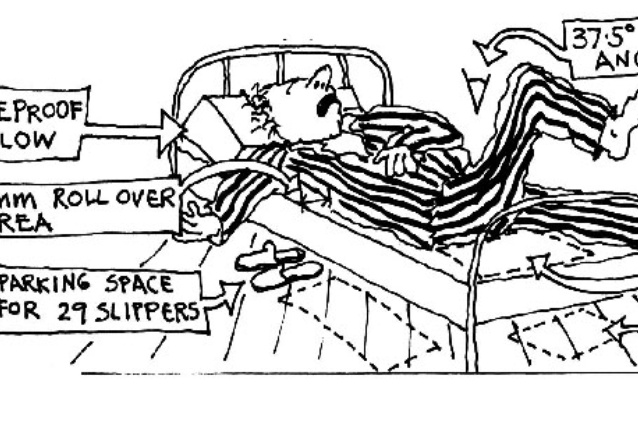
Cartoon poking fun at the obsessive detail required by councils for turning circles, parking spaces, etc. while, according to Walker, big-picture concerns are overlooked.
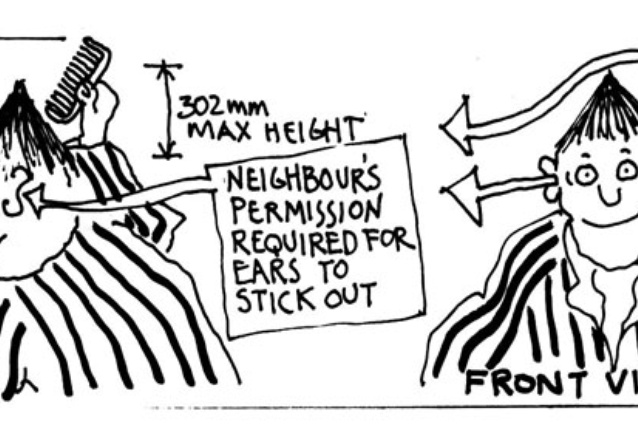
Cartoon shown at Malcolm Walker’s lecture.
I’m hesitant to write about this. I tend to shy from politics, I dislike conflict, and politics falls squarely into the conflict zone. Because I find politics mildly distressing I’m the worst sort of citizen – one who actually has very little knowledge but still some concrete opinions. At least I’m aware of my short falls.
And yet, for all my hesitations, I bring politics up for a couple reasons. The first was that I went to a lecture about Auckland’s Future Today organised by the New Zealand Institute of Architects last week. Architect (and cartoonist and chair of Urban Auckland) Malcolm Walker, as well as chair of Waterfront Auckland and ex-Waitakere mayor Bob Harvey (who I systematically call Bob Hope, further highlighting my limited knowledge of local politics) and Elizabeth Aitken Rose who teaches planning at Auckland University, all spoke on the subject.
The second is that this is an election year, and Rugby World Cup year, and try as I might, I can’t seem to avoid news about Auckland’s development, whether that be the waterfront, and Party Central, or the tram route, or motorway extensions, etc etc.
I felt a bit sorry for Bob Harvey, who didn’t seem to be at all faking his optimism and enthusiasm for Auckland and the new Waterfront development. On a good note, you really did get the impression that he cared. The problem was that he spoke after Malcolm Walker who may not have had the spit polish gusto of a politician, but his talk / rant about the failings of Auckland urban planning, comically highlighted with cartoons that succinctly emphasised how council is obsessively pedantic with architects trying to do good small house renovations, and yet a car park can be built on prime waterfront land. His thesis was that the council’s urban planning was focused on small details, while the big picture was too often waylaid.
Right after Walker laid into how untrustworthy a sketch of a green space filled with perky shoppers and café tables with umbrellas, Harvey showed a slide show of the new waterfront development ideas with perky shoppers and café tables with umbrellas. A huge, monolithic ASB building is to be built on the waterfront, with walkways and green spaces around the Tank Farm. Good in theory, but missed out on fundamentals of good transport, reasons for why people would want to fill that area, rain screens, and shade.
It wasn’t all bad. But it didn’t really fill me with the enthusiasm that Harvey seemed to have. Look, I don’t have the solutions, but I do agree with Walker that designers need to be involved, not just planners – cities are far more than view shafts and axes, and architects and designers are the ones who work daily with people to create aesthetic and atmospheric moments which we should also be looking for with our cities.
And for those of you in Auckland, what do you want from the waterfront? Do you think designers should have more input into the development, not just planners? Tomorrow I’m meeting with the council to hear their plans for Auckland’s development, so this conversation may yet continue.